
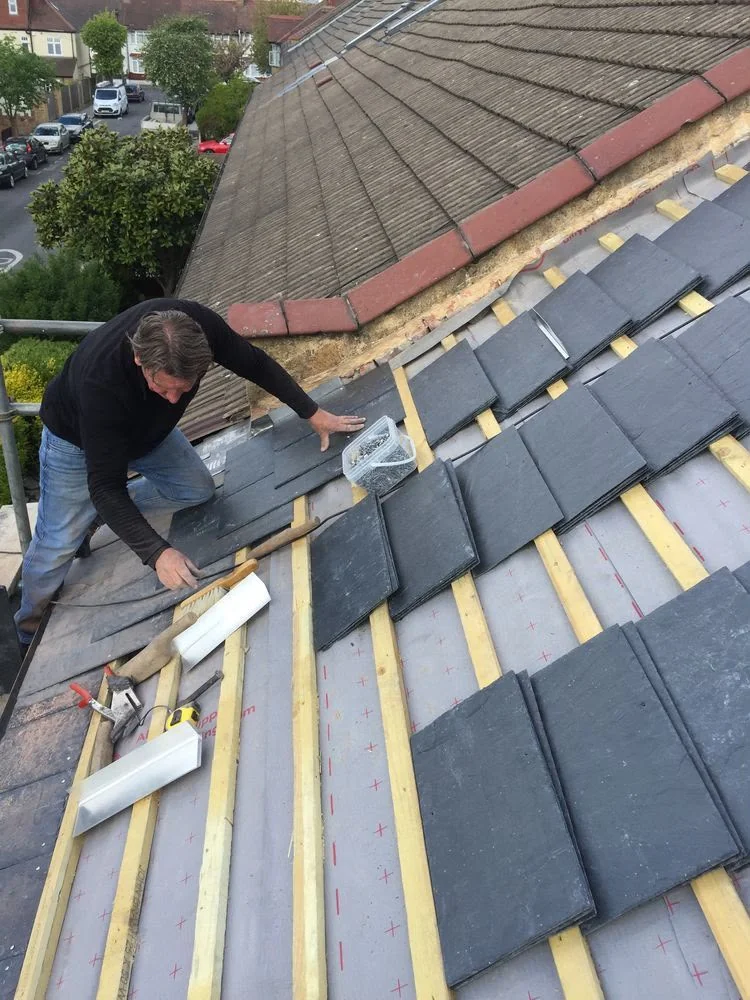
Re-Roofingin Southampton & Bournemouth
Move from recurring roof problems to a considered replacement plan. We discuss the condition, scope and practical arrangements before you commit to re-roofing your property.
£10m cover
Public liability insurance
5–10 years
Workmanship guarantee, depending on works
Free quotes
Discuss your requirements
View our profile
Roofing
A replacement roof starts with understanding the existing one
Re-roofing replaces a roof covering where its condition or the extent of deterioration makes repeated isolated repairs an unsuitable approach. It is not simply a decision to change the visible tiles or slates. The roof needs to be considered as a connected system: covering, supporting layers, junctions, drainage and the construction beneath them all influence whether the building stays protected from rain.
We undertake replacement roofing for commercial and residential properties. A homeowner may need to address an ageing covering; a managing agent may be reviewing recurring leaks across a building; a commercial landlord may need work coordinated around continued occupation. Explain what has happened, what has already been repaired and what you want the replacement to achieve. That history helps distinguish a widespread condition issue from a local defect that may still be repairable.
Professional assessment matters because the area where a stain appears indoors may not be the point where water enters. Replacing sound materials without understanding the route of moisture can leave the original problem unresolved. Equally, focusing on a single slipped tile can overlook deterioration affecting a wider section. The next step is to discuss the actual condition, access and scope, not assume every leak requires a whole new roof.
Who it’s for
- Commercial landlords planning roof renewal
- Managing agents responsible for shared buildings
- Homeowners considering replacement rather than repeat repairs
- Contractors coordinating roofing with wider building work
When to discuss the work
- Recurring leaks despite earlier repairs
- Widespread damage to the covering
- A condition assessment recommending replacement
- Planned refurbishment involving roof renewal
When repeated patching stops addressing the problem
A roof defect can affect more than the roof itself. Investigating its extent helps you decide whether local repairs or a replacement scope makes better sense.
Water reaching the building fabric
Water entering through failed coverings or junctions can wet insulation, ceilings and concealed timber. Decorating over a stain does not stop that route. If moisture continues, the eventual scope may include internal repairs as well as roofing, so record when leaks happen and seek assessment before assuming the visible damage is the whole issue.
Paying for disconnected repairs
Separate patches may be appropriate for isolated defects, but become less useful when deterioration is widespread. Without reviewing the roof as a whole, you can spend on successive visits while the weak points move elsewhere. Compare the likely repair scope with the condition of adjacent sections before deciding on replacement.
Overlooking edges and junctions
New tiles alone cannot compensate for an unresolved detail around an adjoining wall, roof penetration or rainwater outlet. Junctions need to be included in the assessment, with attention to how water is directed away. The finish should be considered alongside the layers and connections that are less visible once work is complete.
Starting without access or approvals
Roofing affects the spaces beneath and around it. Unplanned access can obstruct entrances or put occupants near work overhead. Changes to a roof can also raise planning or building-control questions. Address those matters before work starts rather than discovering them when the covering has already been opened.
How it works
From enquiry to the agreed next step
- 01
Discuss and inspect
Tell us about your existing roof, the property and the changes you have noticed. The covering, visible defects and relevant junctions inform the assessment; safe access determines what can be checked. Access arrangements, occupancy and any immediate safety concerns need to be understood before a suitable scope can be agreed.
- 02
Assess and quote
We discuss the findings, the proposed work and your free quote. Establish what is included, which items depend on further investigation, and whether any separate professional advice or approvals are required. This gives you a scope to consider rather than a price based on guesswork.
- 03
Agree and carry out
The replacement follows the agreed scope, including the identified preparation and roof details rather than just a change of visible covering. Agree access, the sequence of work and arrangements for the people using the property. If concealed conditions change what is needed, discuss the implications before treating additional work as part of the original instruction.
- 04
Review the work
Relevant completion checks consider the covering, junctions and drainage details within the agreed roofing work. Review the completed scope against what was agreed and raise any questions while the work is still easy to inspect. Different materials and repairs need different checks; a visual finish alone does not explain the condition of hidden construction.
- 05
Completion and guarantee
Discuss care of the completed work, any remaining recommendations and the applicable guarantee. Our workmanship guarantee is 5–10 years depending on the works carried out; the terms for your particular work are confirmed rather than assumed to cover every item equally.
What matters for your property
A considered scope. A practical outcome.
A scope matched to the condition
Understanding whether deterioration is local or widespread supports a considered repair-or-replace decision. You can compare the proposed work with the defects it is intended to address, rather than choose a roof replacement solely because a leak has appeared.
Joined-up weather protection
Considering coverings together with junctions and drainage reduces the chance of treating one component in isolation. The aim is a coherent roofing scope that addresses the identified routes of water entry, not merely a different external appearance.
Practical occupied-property planning
Entrances, parking, shared areas and the use of rooms below the roof influence how work should be arranged. Discussing those constraints early helps occupants and property managers understand the agreed arrangements and avoids relying on an unexplained start date.
Clear decisions on materials
A proposed covering should suit the existing structure, roof form and exposure. Asking why a material is appropriate makes comparisons more useful than choosing only by colour or price. No single material is right for every building.
Maintenance you can act on
After replacement, roofs still need attention to drainage and developing defects. Knowing what to look for from a safe position supports timely follow-up rather than treating a new covering as a reason to ignore the roof indefinitely.
Qualified workmanship reassurance
Our workmanship guarantee is 5–10 years depending on the works. Discuss the specific terms for your replacement and keep the agreed scope with your property records, so the reassurance relates to the work actually commissioned.
Roof replacement details worth discussing
Tiles, slates and the existing structure
Tiles and slates vary in weight, shape and the way they are fixed and overlapped. A change of covering needs to be considered against the roof pitch, supporting structure and exposure. Appearance matters, but should not be the only reason to select an option. Materials mentioned here are considerations for assessment, not a promise that a particular product or specification is suitable or supplied for your roof.
For an older property, maintaining the character and behaviour of the existing construction may be important. If the building is listed or subject to other restrictions, check the required permissions before assuming a replacement can change its appearance. Tell us about any previous survey recommendations or known heritage constraints when discussing the job.
The layers below the visible covering
A roof covering is only the part you normally see. Supporting battens, underlayers and the condition of the roof structure can influence the work required. Some conditions become apparent only when existing materials are removed. Agree how findings that alter the scope will be discussed, so hidden deterioration is neither ignored nor treated as an unexplained addition.
Insulation and ventilation should also be considered where relevant to the proposed roof work. These are building-specific questions: existing construction and the intended alteration affect what is appropriate. A roofing quotation should distinguish the agreed work from any separate assessment or alteration needed elsewhere in the building.
Junctions, rainwater and neighbouring roofs
Chimneys, adjoining walls, valleys and connections to other roof areas deserve attention because water can enter at a small failed detail. Ask which junctions are included and whether the work interfaces with a neighbouring property or a shared roof. Responsibilities and permissions should be clear before access or alteration is arranged.
Gutters and outlets affect how water leaves the roof. Debris, poor connections or defects in rainwater goods can produce symptoms that resemble a covering failure. Review the drainage route alongside roof condition and discuss any separate repairs needed, rather than assuming a replacement covering will solve every water-related problem.
Safety, permissions and occupied buildings
Roof work involves risks from height and, in some cases, fragile surfaces. Do not climb onto the roof to obtain photographs or inspect damage yourself. Appropriate access and precautions must reflect the job and its surroundings. Property managers should identify occupied routes, delivery areas and people who may need different access arrangements during the work.
Planning permission and Building Regulations are separate considerations. Roof-covering replacement or changes to the roof may require approval depending on the project. Check with the relevant local authority or building-control service where needed. An enquiry can begin before those questions are resolved, but the planned scope should not assume they are irrelevant.
Planning your re-roofing quote
A useful quotation starts with the condition of the property and an agreed scope. Roof size, shape, covering condition, junctions, access and concealed deterioration can all change the amount of work involved. Give us the property type, the area needing attention, how the building is used and any restrictions on access. Existing photographs can help explain the issue, but take them only from a safe position; they cannot reveal every concealed defect or replace an appropriate assessment.
Compare the scope of different quotations, not just the total. Check what preparation, access, disposal, finishing and follow-up work are included, and what remains outside the instruction. If another contractor or specialist needs to be involved, clarify that responsibility before work starts. We provide free quotes. Large jobs require a deposit; small jobs are paid on completion with no deposit. The arrangements for your job are discussed with the quote.
Re-Roofing near you
- Property services in Southampton
- Property services in Bournemouth
- Property services in Christchurch
- Property services in Totton
- Property services in Hythe
- Property services in Lymington
- Property services in New Milton
- Property services in Ringwood
- Property services in Highcliffe
Acorn roofing, building and maintenance · Contact our team for a free quote
FAQs
Re-Roofing: your questions
What affects the cost of re-roofing?
Cost depends on roof size, the proposed covering, junctions, access and the condition beneath the existing materials. Speak to us about the condition, access and intended outcome so we can provide a free quote for the scope you need. Large jobs require a deposit; small jobs are paid on completion with no deposit.
What is the timeline for re-roofing?
The roof form, weather, access, occupied-property arrangements and any additional defects affect the programme. We discuss the likely programme once the scope and access are understood. Tell us about occupancy, planned events and other work so practical constraints can be considered before arrangements are agreed.
What workmanship guarantee applies?
We offer a 5–10 year workmanship guarantee depending on the works carried out. The applicable duration and terms are confirmed for your job. A workmanship guarantee is not the same as a promise about the lifespan of every material or a guarantee against unrelated defects elsewhere in the building.
What affects the lifespan of re-roofing?
A roof covering’s life is different from the duration of a workmanship guarantee. Durability depends on the existing condition, selected materials, exposure, installation details and ongoing maintenance. Ask about care, inspection and the signs that should prompt another assessment of your particular work.
Can you attend an emergency or come out of hours?
Emergency call-outs depend on our team’s availability, including out of hours where possible. We do not guarantee same-day attendance, a response time or a 24-hour service. Call to explain the situation and confirm availability. Keep people away from unsafe areas; if there is an immediate danger to life, contact the emergency services.
Do you provide re-roofing in Southampton and Bournemouth?
Yes. We work across Southampton, Bournemouth, Christchurch, Totton, Hythe, Lymington, New Milton, Ringwood, Highcliffe. Tell us the property location and whether the enquiry concerns a home, commercial building or managed site. We can discuss the work and access requirements without assuming that every property in an area has the same construction or needs.
Do I need re-roofing or can the roof be repaired?
A local defect may be repairable; widespread deterioration can make replacement a more appropriate option. The decision should follow assessment of the covering, junctions and underlying condition. Tell us about recurring leaks and previous repairs so we can discuss the actual problem rather than assume a whole-roof replacement is necessary.
Can re-roofing be arranged for commercial or managed buildings?
Yes. We work with commercial and residential properties. Explain the building’s use, shared entrances, access restrictions and who can approve the work. Those details matter when agreeing a roofing scope for an occupied site. Any attendance, programme or contract arrangements need to be discussed; they are not automatic service-level commitments.
Your next step
Make a considered plan for your replacement roof
Tell us about the property, the roof’s condition and the repairs already tried. Request a free quote and discuss a replacement scope that addresses the actual building, not an assumed specification.
- Free quotes for your requirements
- £10m public liability cover
- 5–10 year workmanship guarantee, depending on works
Discuss your free quote
Send your requirements through our Contact page, or call our team to discuss your property and the work you need.
Request a Free Quote01590 619306Alternative: 07427 845224